Recommended Links

New Montana Law Blocks the State From Buying Private Data To Skirt the Fourth Amendment
2025-05-16 Reason
High US health care spending is quite well explained by its high material standard of living
2016-09-25 Random Critical Analysis
How do you ask good questions
2021-06-30 Marginal Revolution
Regulatory quality is declining
2022-06-22 Mercatus Center
Computational Analysis of US Congressional Speeches Reveals A Shift from Evidence to Intuition
2025-05-26 Nature

Blog

Thursday, April 30, 2026

How to Evaluate the Electoral College

Main Takeaways

  • The Electoral College has two effects on presidential elections:
    1. It gives a bonus to small states.
    2. It makes the election state-by-state instead of national.
  • Consequently, presidential campaigns target the set of states representing the center of the electorate politically.
  • The Electoral College should not be evaluated in isolation. Because it selects only one branch of the federal government, any representational biases must be understood in the context of the House and Senate.
  • The Electoral College does not, by its nature, favor one party. Its present Republican tilt reflects geography more than partisanship.

The electoral college has been a perennial target of criticism, and after close elections it reliably becomes the subject of renewed calls for reform or abolition. James Surowiecki recently argued that there are simply no good arguments for keeping it, a view that finds plenty of company.

Critics point to the rural overweighting it inherits from Senate apportionment, the distortion it creates between popular and electoral vote outcomes, and the way it currently advantages one party over another. These are concerns worth taking seriously, but they tend to get lumped together in ways that make the electoral college harder to think about clearly, not easier.

Two Effects of Electoral College

There are actually two distinct effects built into the electoral college, and criticism should distinguish between them. The first is the bonus it gives to small states, by virtue of nearly 20% of electoral votes being allocated uniformly across states, regardless of population. The second effect is that the electoral college converts the presidential election into a state-by-state election rather than a national one. These two things are discrete effects, and most critiques of the system are critiques of one or the other.

Fifty Separate Elections

The state-by-state structure is the more consequential feature, and the one that gets the least analytical attention. Because the election is decided state-by-state, only the competitive states actually matter to the outcome. Candidates have little reason to campaign in states they're certain to win or lose, and so the election is effectively decided by the handful of states that could go either way. Those states, almost by definition, are ones where the electorate is closely divided — which means they tend to look like the median of the country. The electoral college, in this sense, pushes the presidency toward the median voter in the median state. That's not a flaw. It's a reasonable thing to want from a presidential election.

Also, by isolating the states, it will tend to push candidates toward policies that favor those states, like no tax on tips benefits Nevada, being pro-union for Michigan and Pennsylvania. This is probably counter to the national interest, but if the election were national, would the promises be broader yet just as wasteful (bigger Social Security checks)?

Small State Bonus

The small-state bonus needs to be evaluated in the context of the full constitutional system, not in isolation. The electoral college is only one piece of the picture — it elects one branch of government. The House, apportioned purely by population, already pulls in the opposite direction in the legislative branch. If you're worried that the electoral college gives small states outsized influence, the House is already correcting for that. A complete accounting of democratic representation has to include both, and when you do, the small-state bias looks considerably less distorting than critics suggest. Consider, too, that by electing the president in a way that accounts for the Senate and the House's modes of representation, it will tend to make the system somewhat smoother. A popular vote election may put the President at odds with the Senate.

Partisan Effect

Finally, the claim that the electoral college structurally favors Republicans is historically wrong, even if it's currently accurate. The underlying mechanism is indifferent to party. What it responds to is the geographic distribution of voters, and right now Democratic voters are heavily concentrated in urban areas, running up large margins in states they were going to win anyway. That's not a design bias — it's a distribution problem. If the parties' geographic footprints were reversed, so would be the electoral college advantage. The current Republican edge is a feature of 2020s political geography, not a permanent thumb on the scale.

The U.S. system is supposed to give states some of the power and not be a top-down national system. If 20 states contain 51% of the US population, the system is supposed to prevent those 20 states from dictating to the other 30 states what their policies should be. As the federal government has absorbed more and more power from the states, the electoral college has served as a bulwark to maintain some of the power distribution originally intended, and still beneficial.

Friday, April 25, 2025

The Other Lesson of I, Pencil

The video of Milton Friedman's "I, Pencil" monologue has been en vogue the last couple weeks due to the recent elevation of international trade into the vibegeist. The underlying message of "I, Pencil" is that no one person could possibly manufacture even something as simple as a pencil.

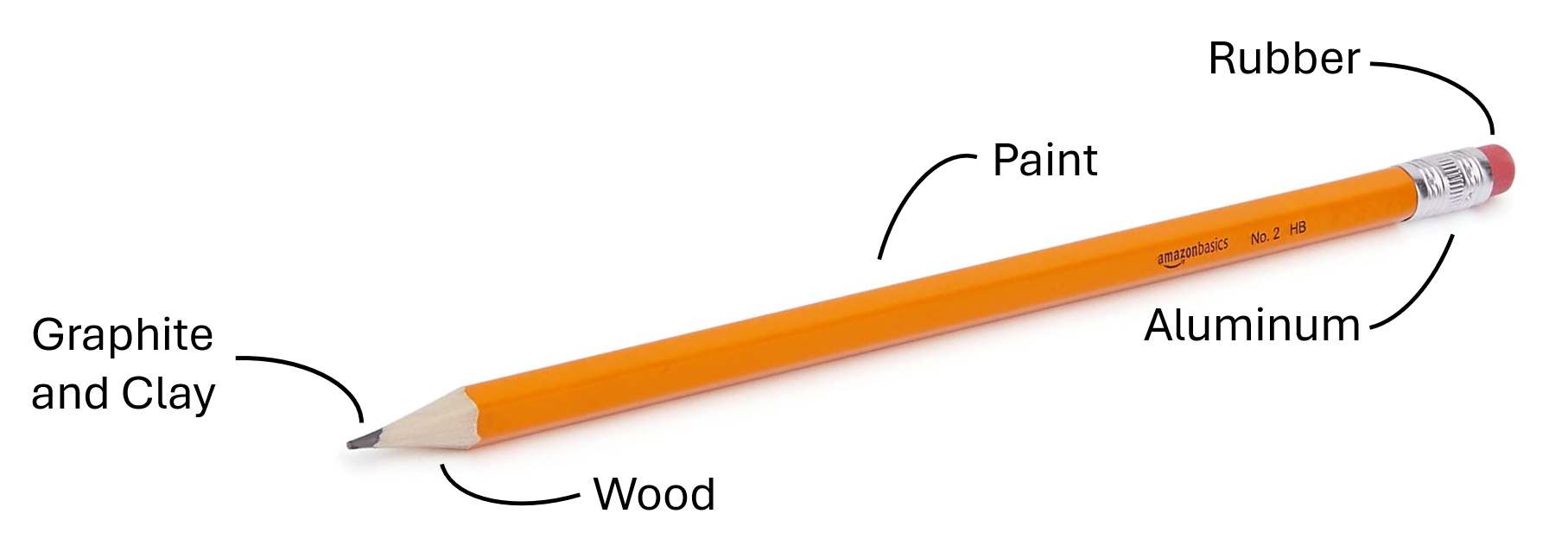
While it has a quite limited set of components—graphite, wood, paint, aluminum, and rubber—each of those components requires its own ecosystem of people, goods, services, and expertise to produce.

Trade is what makes pencils so ubiquitous we can buy them for pennies within minutes and is also what allows for a variety and quality that would be impossible without it.

The pencil and its components, however, illustrate another crucial lesson about trade, one that I tried to describe in my previous post "Trade Makes Us Rich Beyond Measure." Namely, that while "I, Pencil" explains how no single person contains the knowledge or skills to recreate a basic pencil, it's also true that trade opens up a world of components and expertise that are not available in one country. Trade is what makes pencils so ubiquitous we can buy them for pennies within minutes. It also makes them better quality and more diverse than they'd otherwise be. Finally, it allows us to divert our highly skilled, highly productive workforce to more valuable products like nuclear reactors, gas turbines, or spacecraft.

A Global Grocery Store That Sells Everything

While the "I, Pencil" message is that the pencil is not nearly as simple as it seems, a pencil, on its own, comprises just a handful of components: graphite, clay (mixed into the graphite), wood, paint, aluminum, and rubber. Imagine you've been tasked with producing a pencil from scratch, and you have to source these materials. Because of international trade, you have more options than you can possibly research individually.

You can purchase graphite from as nearby as Canada and Mexico or as far away as Madagascar and Mozambique. You can even choose to support Ukraine via purchases of graphite.

The wood in a pencil is typically cedar. The United States is one of the top producers of cedar in the world, so you can get that domestically, but if you would prefer to denude another country's forests, you can go just across the border to Canada or any of a number of countries in South America, Africa, or Asia.

Top 10 Timber-Producing Countries

Forty countries produce more than 1,000 metric tons of aluminum. Countries that span South America, Africa, Asia, and Europe. From the southernmost tip of the inhabited world to the northernmost and in every time zone, there's a country that produces aluminum. The availability of this key metal reflects both industrial capacity and access to the raw ore that is used to produce it.

Aluminum-Producing Countries

Rubber production is more concentrated around the equator, yet there are still three countries in North America, four in South America, ten in Africa, and practically all of Southeast Asia.

For each of these pencil components, you can choose among the countries that produce them, yet also among individual suppliers within those countries. Just like when you're shopping for household items, you can choose based on price of the component, its quality, quantity available, proximity (to manage shipping costs), or even because of a country's politics.

The world is your grocery store, and all of these countries are competing with each other to get you to buy their product based on the factors I listed above. This competition, again like the grocery store, drives down prices and drives up quality and variety.

Ubiquitous Variety

We are swimming in cheap pencils

On Amazon, you can buy 30 pencils for $0.15 each—that's one dime and one nickel. Some people argue that there's a loser and a winner in every exchange, but that is wrong. Both sides are winners. When you buy a pencil, you're giving up a couple of coins and obtaining something that you will use so infrequently, it's more likely that you end up throwing it away than wearing it out. Whoever produced the pencil has even less use for it, and makes money when you buy it. You are both winners. Such is it with every item you purchase.

The pencil choices are innumerable

Not only are pencils cheap, but their variety is bewildering. Jumbo pencils, pencils painted red, and colored pencils.

At Dick Blick, they walk you through how to navigate the dizzying array of pencil options available. You can choose your graphite grade, of which there are at least 24 available on that page and your wood type, of which there are three. Also the shape and diameter of the pencils are options. Just on that one page, I count at least 200 different combinations of options that are available for sale, and it doesn't even include colored pencils.

We Shouldn't Make Pencils in the U.S.

It would be an enormous waste.

The deluge of pencils is only possible because of trade. Having the other 7.7 billion people in the world mining graphite and aluminum ore, mixing paint, harvesting rubber, and producing aluminum, and even producing the pencils abroad and selling them to us enables the variety and cheapness we enjoy. Few people think about this, but one of the reasons the U.S. does not produce graphite is that however much graphite may be available in the United States, its quantities are small and its access is extremely limited, especially when compared to other countries.

Pencils are as cheap as they are because sourcing the materials from countries that have the components in abundance, those components are markedly cheaper than if the U.S. tried to mine graphite domestically. It cannot be emphasized enough that this is a gain. This is a gain for everyone. Because graphite is cheaper elsewhere, Americans benefit, and so do the producers.

This applies to manufactured goods as well naturally occurring ones. The U.S. could surely produce its own aluminum, but consider the costs, not just the cost of building the factories but the loss of economies of scale. The more of a product that one plant produces, in general, the less costly it is to produce on average. It's cheaper to build one large factory with one set of logistics like electricity, HVAC, assembly process, etc., than ten small factories where you'll be needlessly replicating the factory's systems. Also, the employees you hire will be more specialized and more knowledgeable. Ten factories will require ten sets of employees that can do the basics and won't be as specialized or productive as one larger factory, which will enable that factory to produce more pencils, more cheaply than the total across ten factories.

All of these factors add up to one truth of trade—it enables a level of prosperity and abundance beyond what any country can accomplish by itself.

All of these factors add up to one truth of trade—it enables a level of prosperity and abundance beyond what any country can accomplish by itself. This is not because the United States is inferior to other countries in its resources or in its people, but because its resources and its people are limited in number. Even the most productive people in the world only have so much time in a day, and their productivity is enhanced by relying on others to take care of the basics. So it is with a country.

This concept is also demonstrated in this video of a guy making his own sandwich from beginning to end, from scratch. Growing and pickling cucumbers, harvesting wheat, and churning butter to bake bread. Of course, a person can do these things, but they take up so much time and energy, all for a pretty average sandwich. By applying time and energy to one thing, and one thing you're good at and other people value, you can trade your productivity for so much money that you can buy more and better sandwiches made by more experienced and focused people. So it is with a country.

Shifting production from abroad to the U.S., as some politicians want, will mean shifting our unparalleled workforce from high-value goods and services to lower-value goods and services, being less productive and consequently, less wealthy.

Instead of pencils and the other goods we import, our highly productive and knowledgeable workforce can focus on much more sophisticated and valuable goods—industrial turbines, jet engines, nuclear reactors, and more. Shifting production from abroad to the U.S., as some politicians want, will mean shifting our highly focused workforce from high-value goods and services to lower value goods and services, being less productive and consequently, less wealthy.

Conclusion

It isn't obvious, but trade does make us richer. It makes us richer by letting us focus on our strengths and asking others to supply our weaknesses (their strengths). The wealth it creates is immeasurable and we should think carefully about whether the lives we've become accustomed to would still be there in a world without it.

Friday, April 18, 2025

ACA Failures and the Limits of Technocracy

Back in September, I evaluated the performance of the Affordable Care Act (ACA) with regard to some of the prevailing major problems in healthcare. In this review, I considered the rate of uninsured Americans, the affordability of healthcare, and average life expectancy. These were all issues being discussed up to that point and were used to advocate for its passage. The only goal it even partially achieved was reducing the uninsurance rate, which it did entirely by simply expanding Medicaid.

Since then, experts have shown that some of the healthcare reform's less high-profile objectives have failed as well. Below, I go through three other elements of the ACA—Accountable Care Organizations, Electronic Health Records, and the Center for Medicare and Medicaid Innovation. For each, I highlight the lofty promises made at the time and compare to real-world results.

Looking at the ACA in its entirety, all the projects it entailed and the outcomes it was supposed to effect, one's conclusion should not be that "government always fails" or that "we can do it better next time", but that societal engineering through government policy is much more difficult than we imagine.

Looking at the ACA in its entirety, and all the projects it entailed, and all the outcomes those projects were supposed to effect, one's conclusion should not be that "government always fails" or that "we can do it better next time", but that societal engineering through government policy is much more difficult than we imagine.

Accountable Care Organizations (ACOs)

The Promise

Accountable Care Organizations were a novel approach to providing care to patients. Instead of patients going from one doctor to an unrelated hospital to an unrelated lab and being responsible for managing their own care, hospitals, doctors, nurses, and other specialists would join together into an ACO and coordinate care for the patients. These ACOs were paid according to their performance. If they increased value, they'd receive a bonus, but if they underperformed, they might be financially penalized.

When the Affordable Care Act introduced Accountable Care Organizations, policy experts and media outlets lauded them as a revolutionary approach to improve care coordination and cut costs. They were touted as the forefront of the shift of healthcare from being an industry focused on volume to one focused on value. In early 2011, an NPR/Kaiser Health News explainer noted ACOs had become “one of the most talked about provisions” of the new law, offering a “possibly less costly model” of care that keeps quality high while tamping down expenses​.

Accountable care organizations take up only seven pages of the massive new health law yet have become one of the most talked about provisions.

The policy commentariat argued ACOs would break down the silos in health care. Instead of fragmented treatment, patients would get “seamless” care as providers work together. By holding a single organization responsible “across a continuum of care,” ACOs were intended to reduce the errors, duplication, and frustration that patients faced under disjointed care​.

The Reality

In a recent, Health Affairs Article, authors dug into the performance of ACOs. They discovered that, contrary to promises and announcements to the contrary, ACOs produced no real savings and sometimes, on net, were more costly than non-ACO provision of healthcare.

CMS reported MSSP savings create the veneer of savings when little to none exist.

ACOs are basically behaving the same way Medicare Advantage plans are. When determining their payments, CMS compares their performance to an artificial and inflated benchmark. This creates an accounting illusion where they appear to be producing net gains when they're not. They achieve this by exploiting favorable selection, upcoding, and other means which, while legal, defy the spirit of the system it's abusing.

Among the ways they manipulate the program, ACOs can drop out and re-enter the pay-for-performance system at will. Because the performance system rewards improvement and punishes failure, ACOs can time their participation so it's all upside and no downside. ACOs can also select which practices are evaluated, so if they select the ones that are improving and exclude those that are underperforming, they can improve their own scores.

ACOs were supposed to drive the healthcare system to be more value-based, reducing cost and improving outcomes, but the actual result is an additional layer of complication that some enterprising people have engineered a way to game without producing any results. Upon hearing this, the natural impulse will be to keep the underlying system and address the errors that have been identified so far. That impulse should be resisted.

A group of system designers cannot be as smart as the thousands of participants who will be looking for ways to make the system work for them.

The Commonwealth report identified several potential pitfalls of the ACO endeavor. Notably, gaming the system was not listed. In a complex system, the methods of failure are rarely foreseeable, and for every hurdle identified, there are myriad more that can occur. A group of system designers cannot be as smart as the thousands of participants who will be looking for ways to make the system work for them.

Electronic Health Records (EHR)

The Promise

The push for electronic health records was heralded as a cornerstone of modernizing health care during the ACA era. Prominent advocates from the White House to health IT experts argued that digitizing medical records would save money, save lives, and improve care. For example, in early 2009 soon-to-be-President Obama announced a major health IT initiative​, declaring “within five years, all of America’s medical records are computerized. This will cut waste, eliminate red tape and reduce the need to repeat expensive medical tests… it…will save lives by reducing the deadly but preventable medical errors.”

Advocates predicted EHRs would eliminate costly inefficiencies – reducing paperwork, duplicate tests, and administrative overhead. Obama’s team argued digitization would “cut waste” and save billions in unnecessary spending​. A widely cited RAND analysis from 2005 even projected over $80 billion in annual savings if EHRs were broadly adopted. The prevailing message was that going electronic would streamline care delivery and bend the cost curve downward.

The Reality

Suffice it to say, we do not live in the high-tech paradise that many envisioned. The healthcare system is not markedly different from fifteen years ago. Physicians have been bogged down with additional administrative burdens.

Instead of solving the problems of paper records, EHRs have simply digitized them—and created new problems along the way.

In addition to the administrative burden, studies have found the adoption of EHRs has "decreased patient-provider interaction, security breaches, and overdependence on technology". Instead of improving healthcare, providers used the data to increase revenues by performing additional procedures and by reducing patient visits. Experts say that EHRs fail to enable practitioners to convert their practice's clinical information into productive actions.

Like with ACOs, EHRs were a promise that has gone unfulfilled. Several problems were not foreseen. Startup costs were significantly higher than anyone predicted, and while EHRs increased information transfer within organizations, the systems put in place were often tailored to individual providers, so external transfer has not been improved. Also, there are two major providers of EHR systems and they have an incentive to not be cross-compatible. Lastly, while EHRs enable healthcare providers to communicate more easily, they also facilitate data analysis for providers to increase their revenues through upcoding (see above) and other means.

Centers for Medicare and Medicaid Innovation (CMMI)

The Promise

Policymakers and wonks portrayed CMMI as the engine that would test and scale up the best ideas to achieve healthcare's Triple Aim. The law charged the new Innovation Center with finding ways to “improve healthcare quality and reduce costs” in Medicare and Medicaid​. Upon its launch, officials made lofty promises about its potential. CMS Administrator Donald Berwick touted that “The Innovation Center will [identify] models of care that both improve the quality of care patients receive and lower costs.”​

Commentary stressed that CMMI would rapidly experiment with novel payment and care delivery models – from bundled payments for episodes of care, to medical homes, to preventive health initiatives. The goal was to find “what works” in improving outcomes and efficiency.

This was heralded as an unprecedented opportunity to innovate in real time. Think tanks like the Center for American Progress cheered it, avowing that alternative payment methods under CMMI are “key to transforming how we deliver care, to lowering costs, and to improving quality.”​

The Reality

In a 2023 CBO Analysis, economists determined that between 2011 and 2020, CMMI increased total costs by $5.4 billion. It spent $7.9 billion in order to save $2.6 billion—a result entirely at odds with the program's intent. The Center, designed to innovate its way to reduced spending, ended up costing more than it saved. Avalere Health conducted their own evaluation, reviewing a sample of projects and found that they produced a net loss of $6.4 billion. In theory, the models Avalere reviewed would pioneer a shift to more value-based care. In practice, most were abandoned after lackluster results.

Now, that's not a huge amount of money in the context of the U.S. budget, or even CMS spending, but CBO originally projected it would save $1.3 billion on net over ten years. CMMI was supposed to be a policy engine— a platform that could test, learn, and scale. Instead it became yet another regulatory cog in the wheel of government. It doesn't produce anything of value, but it still keeps spinning.

CMMI proves once again how difficult it is to engineer grand results and also that the difficulties are persistently underestimated. Time has shown that it is counterproductive and should be dropped.

Conclusion

The ACA provides numerous examples of how advocates of government-led solutions to complex problems are overly optimistic. Medicaid expansion is its only accomplishment that can be deemed even a partial success, and its success is entirely attributable to it being a simple expansion of spending on an existing product. Despite an attempt to produce larger benefits through smart regulation and technocracy, the only reason the ACA succeeded in any endeavor is because it threw money at a problem. The healthcare system is no different than it was 20 years ago. It's not more affordable, more efficient, or more value-based. It's the exact same system just with more government money and intervention.

Time and again, well-intentioned, government-inclined disrupters propose new programs and considerable spending with the promise and prediction that it will improve the systems that are broken or save taxpayers money. In the majority of cases, these promises fail to materialize, the public forgets that they were made, and we end up stuck with programs that make the system more complex without any improvement in outcomes. Looking forward, we should end-of-life the failed experiments and redouble our skepticism of future projects and their overpromises.

Tuesday, April 15, 2025

How I'd Argue Meta v FTC

I haven't followed the FTC Meta case very closely so far, but reading some posts about it, I generated too many reactions to contain without writing down and sharing. Mostly, I just think the entire case is unnecessary and irrelevant.

Many such cases rely on the market definition, which is crucial. Quickly, to be able to show that a firm is controlling a market, you have to define what market they're controlling. I'm familiar with hospitals, so geography was an important aspect, but for this case, the product market is what's important.

The FTC generally wants to define the market as narrowly as possible because the narrower the market, the easier it is to show concentration. Conversely, firms want to define it broadly. Unsurprisingly, there's some argument over the market definition. FTC defines the market as "Personal Social Networking Services" (Facebook, Instagram, Snapchat, and MeWe). Meta contends the market it competes in is much broader, though I'm unable to find a precise definition. At a minimum, they want to include TikTok and YouTube.

I do recommend this substack article by Brendan Benedict, who is knowledgeable on the topic and in the courtroom. But when I read through the activity and the arguments, I can't help but wonder at Meta's strategy. Here are some points I'd make if I were involved, though they'd surely need to be translated to legalese.

Firstly, I don't buy that Instagram and Facebook compete with each other in the conventional way. Consider the entire social media industry. To me, it seems stratified by purpose and also by medium. As far as user base, there's NextDoor for neighbors, LinkedIn for professionals, Facebook for socialization. Then, by medium, X focuses on microblogging, Facebook posts of friends, Instagram for images, and TikTok and YouTube compete a little on videos.

Do any of these platforms really compete with each other? If any of them go down, you may reallocate your time to some of the others, but what you'll be doing, and your audience, will change drastically. I don’t think they’re really competing for the same consumers the way Coke and Pepsi or GM and Ford do.

If Facebook hadn't bought Instagram, what do you really think the outcome would be? My suspicion is it would either be its own company and be basically the same as it is now in functionality and user base, or it would've been bought by someone else and be basically the same as it is now in functionality and user base.

Antitrust experts call this the but-for world. What would it look like but-for this acquisition. It's hard to imagine it would be much different.

User Base or Advertisers

Maybe this will become more clear as the case progresses, or maybe I'm just not well enough informed, but I'm not quite understanding the interactions between the market definition with regard to users, and the market definition with regard to advertisers.

The age of the internet and internet companies have made antitrust analysis more challenging because many of the companies give their products away to consumers for free. So, what has happened with Meta in the past is that they use advertising as the market. If a social media company is a monopoly, it can use its monopoly power to command higher prices from advertisers. But the market definitions I've seen haven't made reference to advertisers, and I don't think advertisers focus their dollars the way the FTC is defining the market. Even if users considered Facebook and Instagram closer substitutes, do advertisers? Surely if Meta raised its ad prices, those advertisers would shift to TikTok.

In summary, I have yet to understand how these two factors are related to each other, but maybe I'll learn that going forward.

Theoretical Tests of Market

I can think of three potential hypothetical market tests in this case. A hypothetical market test, essentially, is saying "Would a potential merged firm raise prices without losing so many customers it's not worth it?" But, as mentioned before, prices are zero for users of social media services. However, there's no reason you can't use quality instead of price. So the three questions are:

  1. Can Facebook+Instagram raise its price to users and it lose fewer customers than they would if they didn't merge?
  2. Can Facebook+Instagram lower its quality to users and lose fewer customers than they would if they didn't merge?
  3. Can Facebook+Instagram raise its price to advertisers and lose fewer advertisers than they would if they didn't merge?

Now, these aren't the formal questions, but they're the essence of what the questions are meant to determine. If the answers to any of these questions is yes, then the FTC wins the argument. To me, though, I'm not sure if the answers to any of them are yes. It's early, though, and I'm sure I'll learn more over the next couple days.

Tuesday, April 15, 2025

Oren Cass's Case for Trade

I cannot recommend more highly this Ross Douthat Interview of Oren Cass. Douthat treats Cass as a serious thinker and with respect. He asks excellent questions and gets thoughtful answers that help characterize Cass's views.

I don't agree with Cass on very much regarding trade, and his style of speaking is nebulous and difficult to parse for succinct arguments. Also, on Twitter, he's more aggressive and personal than I prefer, but it's still worth taking his point of view seriously.

In this interview, a few main throughlines emerge. Unlike the MAGA protectionists, Cass is dubious of some of the arguments regarding tariffs, though he's careful to not dismiss them outright. For example, he's not really sold on the abrupt Trump approach but thinks tariffs need to occur more gradually.

Below are the fundamentals of the Cass trade system.

  1. The 2025 American economy, despite the commonly used metrics, is not working.
    • Income, unemployment, and GDP do not account for the high prices Americans pay for fundamental material necessities of life like education, homes, cars, healthcare.
    • Economic metrics exclude non-economic aspects of life—family, security, etc.— which have diminished the past 50 years.
    • Not all groups are keeping up. Young men, particularly in the rust belt, are falling behind.
  2. The national security rationale - We need to build defense products domestically.

For these reasons, he supports a broad tariff; he's happy with the across-the-board 10% tariff Trump imposed. He supports a much higher tariff on China because they're a hostile state but also is open to freer trade with friendly countries as long as they (1) adhere to the larger goal of isolating China and (2) have "balanced" trade restrictions with the U.S.

Where I disagree

First, even though I'm an economist, I'm not going to say that everything is better for everyone in the U.S. today compared to 1975. It's true that life is a lot cheaper overall, and the standard of living is a lot higher for the vast majority of Americans. I don't think there are many people who would choose to live in 1975 over 2025.

That being said, I agree with him that men in the rust belt who are not college-educated, as a demographic group, have probably done the worst in the past 50 years as the economy evolved. Despite that, I don't believe the solution to the relatively slow growth for one group of people to hold the rest of the country back.

The left often solves these problems by redistributing wealth; the right's solution used to be laissez faire, and letting them work themselves out; Cass represents a new right, though, and he wants to redistribute opportunity instead of wealth. By imposing tariffs and trade restrictions, he wants to promote domestic manufacturing jobs at the expense of trade-based jobs. This will cause an enormous amount of harm—much greater than the gain to this one demographic group.

It's a challenging problem to solve because it involves several frictions in the choices of individuals. Individuals might need to retrain, switch industries entirely, relocate. All of these are very difficult, and especially so if the economic changes are abrupt. Up until 2020, more and more men were getting college degrees, which helps solve the problem, and incomes for high-school graduates did rebound since 2015 after declining over the previous decades.

Still, the solution to this problem is not to hold back or reverse the gains the country has made. A huge proportion of America has gained from having the most dynamic economy in the world, and winding the clock back 50 years to a time where there was more manufacturing, for a single American demographic will surely do more harm than good.

In addition to that, there's no reason to believe that Cass's system will benefit the people he's worried about disproportionately. Later in the interview, he argues that he views the 10% broad tariff as a free market solution, meaning that the U.S. economy will figure out the best way to achieve his goal of reshoring production. This will mean we pay more for certain goods, but we also produce more of other goods, in whatever configuration that is most economical/profitable.

Why does he believe that the final configuration will mean more jobs for 25-45 year old, high-school educated men in the rust belt? There's every reason to believe that production will favor the South where people have been moving and have more attractive environments for business investments. There's no reason to believe that the jobs that are created won't favor the same types of people who are already doing well.

Prices of the Fundamental Goods Won't Go Down

At American Compass, we look at the cost of attaining the sort of basics of middle-class security, like health insurance, housing, transportation, the ability to send your kids to public university, a basic basket of food. Now, that frustrates economists because that’s not the standard inflation measure, but those costs resonate with a lot of people because it speaks to the reality of their lives. It has become much harder for the typical worker to afford all of that, especially on one income."

Firstly, I am in no way frustrated by choosing these goods. I think there's merit to it, even if it does neglect many goods that people like to buy. There's much more detail at American Compass's website.
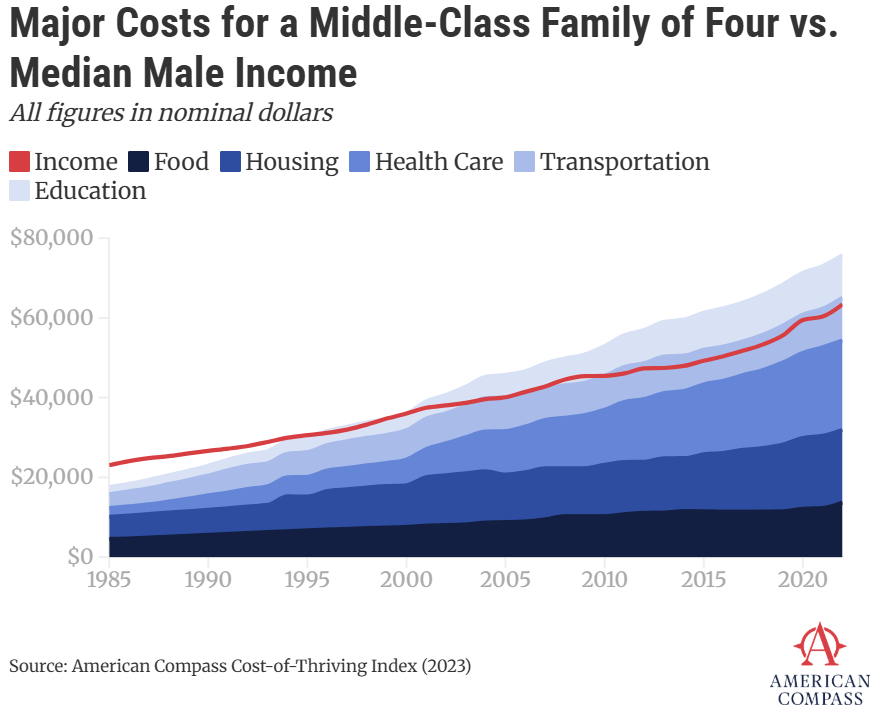
This graphic does a pretty good job illustrating his point. The red line represents income, and the other lines are the combined costs of Food, Housing, Health Care, Transportation, and Education. Notice how in 1985, a single median male could afford all of these items for his family of four, and that is no longer the case in 2022.

However, one should note a few things. The difference isn't all that large. In 1985, the earner is barely able to afford these things, and by the end, he's barely unable to afford them. Secondly, the categories that increased the most were Housing, Health Care, and Education. The others stayed proportional for the most part. Health Care is double-counted, too. In the index, they use the full premium, which is partially paid by the employer. If you do this, that part of the premium should also be included in the weekly income.

Education and Housing both go up, but largely because these items are paid for by dual-earning households coupled with the limited growth in the supply of these products. The better solution for both of these is to work toward greater supply.

Lastly, like with the previous criticism, it's unclear if or how tariffs will fix these problems. Tariffs will not lead to fewer dual earners, more universities, or more homes. They'll probably make housing more expensive, in fact, as well as transportation, food, and health care. Will wages go up for the one slice of the population that has fallen behind? If so, is the plan essentially to limit the success of the couples, so they won't bid up prices of the same products that the single-earner wants to buy for his family.

The National Security Argument

National security is one of the better reasons advocates give for protective tariffs. In the event of a war, we want to make sure we can produce all the weaponry and equipment we will need to win. To me, though, while this makes sense in the abstract, there are a hundred issues and possibilities that need to be considered. Would it be acceptable to divide up wartime essentials among our closest allies or can we not trust them either? The United States has transitioned its economy at the outset of a war several times in the past and still won those wars; surely for some products we can just be prepared without actually producing those items during peace time.

What Cass is actually proposing becomes somewhat hazy here. Douthat asks if, for national security, we should just focus on a couple highly important products like chips. Cass says "If you actually want to be an industrial power, you need the actual materials themselves. You need to know how to make the tools that make the materials, things like machine tooling, the actual excellence in engineering that’s going to lead to efficient production." He then says he thinks of tariffs as a free market solution, so it's extremely unclear how he wants to effect the national security component

Cass seems simultaneously opposed to using tariffs to single out certain products, but also implies that America needs to produce national security goods at every point of the process, from nuts and bolts to finished missiles. Beyond the internal contradiction, producing every screw, bolt, panel, etc, etc, etc, for our incomprehensibly sophisticated Air Force jets, nuclear submarines, and intercontinental ballistic missiles would require committing a tremendous percentage of the nation's economy to achieve, if it was achievable at all, considering some of the raw materials may not be available in the U.S.

Conclusion

Oren Cass has a mostly coherent, and much more focused vision of trade and what it should achieve than most of his allies on the issue. Still, it is not fully fleshed out and leaves many important questions unanswered. I retain my view that he's more wrong than right, but at least I understand him better because of this interview.

Some Interesting Excerpts and Selected Reactions

But when we're looking at the actual well-being and flourishing of the typical working family and their ability to achieve middle-class security, we've seen real decay.

Cass believes the current economy looks very good, but it's a temporary bright spot on a downward slope.

When you’re looking at these household income numbers, it’s important to notice how much they rely upon the household having two earners and how much more reliant they find themselves on government programs than in the past. I also think it’s important to notice rising inequality, which conservatives have traditionally pooh-poohed in the last 40 years. That’s because you’re not supposed to have any right to complain about the broader shape of the society as long as you have more stuff than you did 40 years ago. But I think we’ve seen a very clear divergence in the fortunes of the typical worker, who does not have a college degree, and the upper middle class, who has seen so much of the benefit.

At American Compass, we look at the cost of attaining the sort of basics of middle-class security, like health insurance, housing, transportation, the ability to send your kids to public university, a basic basket of food. Now, that frustrates economists because that’s not the standard inflation measure, but those costs resonate with a lot of people because it speaks to the reality of their lives. It has become much harder for the typical worker to afford all of that, especially on one income.

...What people are seeing instead is that some people got to march ahead into the brave new future and a lot of folks did not. This may be somewhat narrow, but I think it’s really important to look at particular groups, like young men, if you want to know how your society is doing."

Cass here is saying a couple different things. First, that the measures of economic prosperity are misleading because they're based on dual incomes and government transfers. Also, he highlights income inequality, which was once the primary preoccupation of the left. It was a very big issue in the mid-2000s for Democrats. Books were written on it. This was true when the Bush II economy was doing remarkably well before the financial crisis.

To this, Douthat asks the very reasonable and natural question, what trade has to do with this.

Cass responds:

What we have seen going back into the ’90s after NAFTA, and certainly after welcoming China to the World Trade Organization, is a real hollowing out of the manufacturing sector.

The loss of manufacturing has been a serious problem, and trade is at the heart of that. So, figuring out how to make it relatively more attractive to make things here in America is therefore becoming a really big — and correct — focus for policymakers.

A flatlining in the manufacturing sector is a form of collapse that weakens the American ability to essentially keep up in all sorts of vital areas.

Seemingly contradicting himself, Cass says:

I think it's important to say that there's nothing especially valuable in the abstract about a manufacturing job

But this goes back to underscore the main reason he cares about manufacturing in the opening of this post: 1) the people who used to have manufacturing jobs have been left behind and these jobs are the best way Cass sees to reinvigorate them and 2) national security.

...one thing that is very good about manufacturing jobs is where they tend to be located. If we want a broad prosperity with diffusion across the country, then it’s important to have strength in a variety of sectors in different places, not just knowledge work that’s going to agglomerate in a few big cities.

It’s also the case that if you want to have good, highly productive jobs that pay a good wage, empirically, what you see is that those opportunities exist in the manufacturing sector, especially for people with less formal education, even though the average manufacturing job doesn’t pay more than the average services job.

Short-term vs long-term

The funny thing is that when we have talked about short-run costs of globalization, economists just waved them away and said, Oh, don’t worry. Let us tell you about our long-run equilibrium model that says, you know, someday this will be for the best.

It’s only when you’re talking about policies that are not their ideological preference that they suddenly zoom in and focus very heavily on the immediate short-run transition costs. So I certainly acknowledge there are short-run costs, but I think they’re worth it.

I don't think this is true at all. Economists do tend to talk about the long-term costs, but they talk about short-term costs as well. And in this case, economists worry about both the short- and long-term costs of tariffs.

Not only because of the other things beyond G.D.P. that we might accomplish, but I think they’re also worth it because they point in the direction of a much stronger and healthier economy in the long run. And so we’re looking at what trajectory is the right one for the American economy across the next generation or two.

I absolutely think that we’ll be much better off if we make a commitment to reindustrialization rather than saying, Well, according to the economic model, we should just be happy with everything being produced in China because it’s more efficient there and we get cheaper stuff."

Cass truly believes in the long-term benefits of tariffs.

National Defense

I think it’s really important to recognize that you can’t maintain a strong defense industrial base independent of a strong industrial base. We’ve essentially tried to do that. We’ve said we still need to be able to make our own aircraft carriers and submarines and fighter jets and so forth. But the other stuff doesn’t matter because it’s not national security.

If you actually want to be an industrial power, you need the actual materials themselves. You need to know how to make the tools that make the materials, things like machine tooling, the actual excellence in engineering that’s going to lead to efficient production.

Here, he's saying that the U.S. needs to produce all elements of the national security products, from nuts and bolts to finished missile.

Tariffs as a Nudge

I always emphasize that I actually see tariffs as the much more free-market position. Because, yes, they are a significant intervention into the market, but they are a relatively simple, broad and blunt one. And once you’ve changed the constraints such that domestic production is relatively more attractive, you then are able to leave more to the market to figure out. Under these conditions, what else do we want to produce here? And how do we do that effectively?

Cass sees tariffs as a sort of carbon tax or cap and trade. A single price to orient the entire market, but let the market figure out how best to do that. I don't think this works. On a carbon tax, for example, you set the price to target a specific level of carbon, and then you let factories decide who pollutes more and who pollutes less, but the total is set. With industrial policy, there is no specific target. Cass's goals are to lift up a single demographic category and reshore defense production. Neither of these things is best accomplished through a broad tariff, unlike a carbon tax.

I think the most constructive agreements we’re likely to reach are around pushing toward balanced trade and around pushing toward getting China out of our markets. I think we can make a lot of progress there. I don’t think we’re going to solve our deficit problems through those negotiations.

Recent Posts

The Other Lesson of I, Pencil
April 25, 2025
ACA Failures and the Limits of Technocracy
April 18, 2025
How I'd Argue Meta v FTC
April 15, 2025
Oren Cass's Case for Trade
April 15, 2025
Medicaid Reform Cheatsheet
April 10, 2025
Five Things Miran Gets Wrong in His Trade Manifesto
April 6, 2025
Tariff Calculus
April 4, 2025
Trade Makes Us Rich Beyond Measure
March 31, 2025
Medicaid Provider Taxes - An Explainer
March 27, 2025
Cutting Medicaid is Possible
March 24, 2025

Topics

ACA | healthcare | Biden | Supreme Court | FTC | Social Cost of Carbon | insurance | EPA | Social Security | trade | IRA | climate | 2024 | tariffs | CMS | Medicaid | student loan | policy | Trump | technocrat | environment | IRS | spending | regulation | technocracy | CO2 | inflation | budget | social media | Harris | Musk | deficit | subsidies | instagram | MA | solar panels | Hayek | Krugman | COLA | covid | Democrats | exchange | discretionary | debt | standing | ports | moderation | ehrlich | poverty | mandate | SNAP | Necessary and Proper Clause | law | foreign aid | CMMI | discretionary spending | waste | meta | Bidenomics | administrative costs | energy | market | Medicare | banks | shortage | median voter | money | competition | net neutrality | loan forgiveness | Romney | retirement | Citizens United | provider taxes | overpopulation | Vance | Interstate Commerce | CTC | charity | Healthcare Reform | anti-trust | PEPFAR | EHR | non-compete | governance | exchanges | economy | taxes | antitrust | central planning | Medicare Advantage | solar | AI | 2020 | health care | supply | election | currency | unions | tariff | loans | CBO | sowell | NetChoice | health insurance | population | Strict Constructionism | discount | Child Tax Credit | USAID | ACO | DOGE | government |

Archive