
Main Takeaways
- The Electoral College has two effects on presidential elections:
- It gives a bonus to small states.
- It makes the election state-by-state instead of national.
- Consequently, presidential campaigns target the set of states representing the center of the electorate politically.
- The Electoral College should not be evaluated in isolation. Because it selects only one branch of the federal government, any representational biases must be understood in the context of the House and Senate.
- The Electoral College does not, by its nature, favor one party. Its present Republican tilt reflects geography more than partisanship.
The electoral college has been a perennial target of criticism, and after close elections it reliably becomes the subject of renewed calls for reform or abolition. James Surowiecki recently argued that there are simply no good arguments for keeping it, a view that finds plenty of company.
There's no good civic argument for the electoral college. It was arguably necessary to ensure the ratification of the Constitution, but it's an anti-democratic device that gives some American citizens far more voting power than others, based purely on where they live. pic.twitter.com/AFeKWHJ1ws
— James Surowiecki (@JamesSurowiecki) April 16, 2026
Critics point to the rural overweighting it inherits from Senate apportionment, the distortion it creates between popular and electoral vote outcomes, and the way it currently advantages one party over another. These are concerns worth taking seriously, but they tend to get lumped together in ways that make the electoral college harder to think about clearly, not easier.
Two Effects of Electoral College
There are actually two distinct effects built into the electoral college, and criticism should distinguish between them. The first is the bonus it gives to small states, by virtue of nearly 20% of electoral votes being allocated uniformly across states, regardless of population. The second effect is that the electoral college converts the presidential election into a state-by-state election rather than a national one. These two things are discrete effects, and most critiques of the system are critiques of one or the other.
Fifty Separate Elections
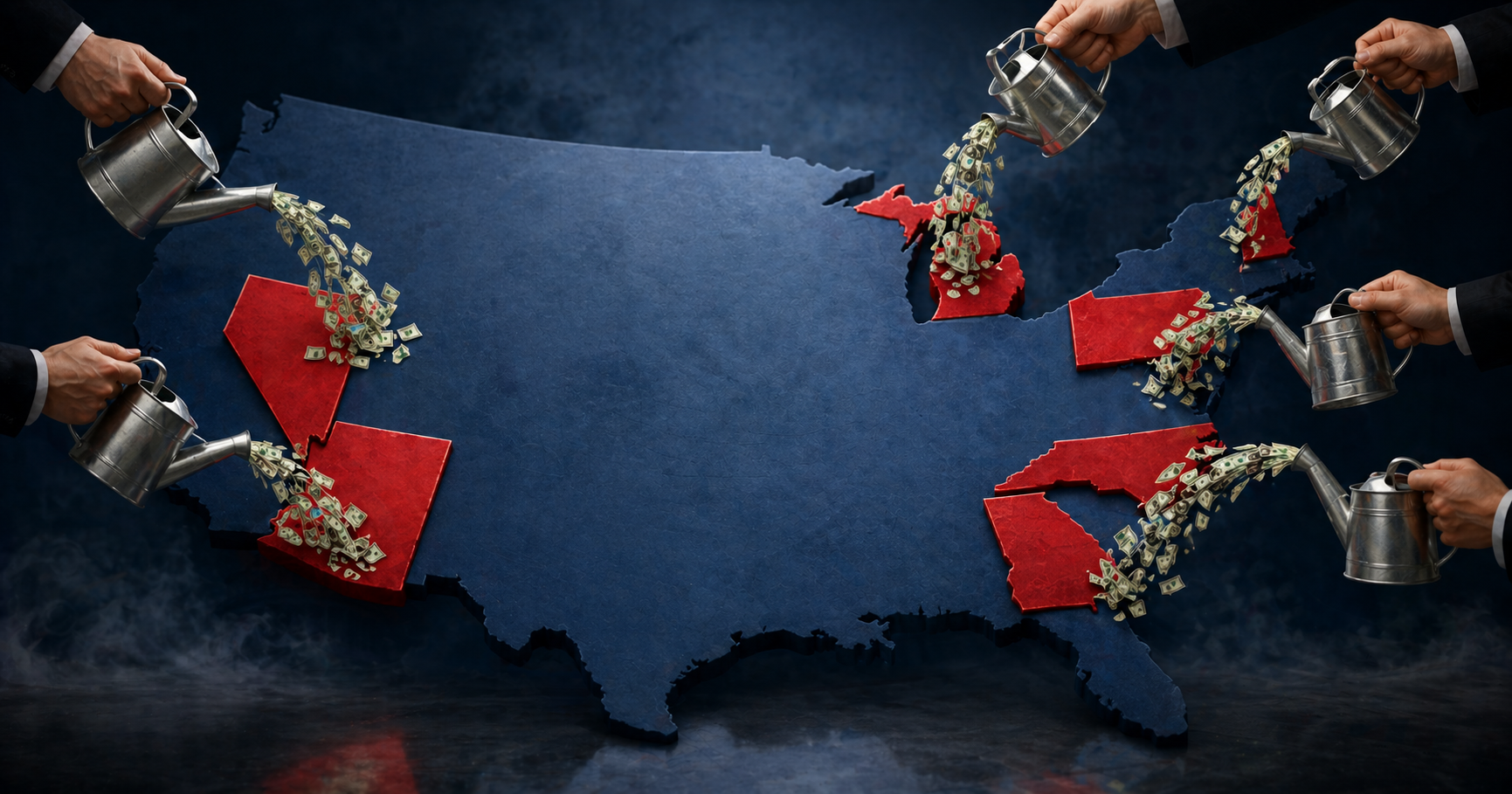
The state-by-state structure is the more consequential feature, and the one that gets the least analytical attention. Because the election is decided state-by-state, only the competitive states actually matter to the outcome. Candidates have little reason to campaign in states they're certain to win or lose, and so the election is effectively decided by the handful of states that could go either way. Those states, almost by definition, are ones where the electorate is closely divided — which means they tend to look like the median of the country. The electoral college, in this sense, pushes the presidency toward the median voter in the median state. That's not a flaw. It's a reasonable thing to want from a presidential election.
Also, by isolating the states, it will tend to push candidates toward policies that favor those states, like no tax on tips benefits Nevada, being pro-union for Michigan and Pennsylvania. This is probably counter to the national interest, but if the election were national, would the promises be broader yet just as wasteful (bigger Social Security checks)?
Small State Bonus
The small-state bonus needs to be evaluated in the context of the full constitutional system, not in isolation. The electoral college is only one piece of the picture — it elects one branch of government. The House, apportioned purely by population, already pulls in the opposite direction in the legislative branch. If you're worried that the electoral college gives small states outsized influence, the House is already correcting for that. A complete accounting of democratic representation has to include both, and when you do, the small-state bias looks considerably less distorting than critics suggest. Consider, too, that by electing the president in a way that accounts for the Senate and the House's modes of representation, it will tend to make the system somewhat smoother. A popular vote election may put the President at odds with the Senate.
Partisan Effect
Finally, the claim that the electoral college structurally favors Republicans is historically wrong, even if it's currently accurate. The underlying mechanism is indifferent to party. What it responds to is the geographic distribution of voters, and right now Democratic voters are heavily concentrated in urban areas, running up large margins in states they were going to win anyway. That's not a design bias — it's a distribution problem. If the parties' geographic footprints were reversed, so would be the electoral college advantage. The current Republican edge is a feature of 2020s political geography, not a permanent thumb on the scale.
The U.S. system is supposed to give states some of the power and not be a top-down national system. If 20 states contain 51% of the US population, the system is supposed to prevent those 20 states from dictating to the other 30 states what their policies should be. As the federal government has absorbed more and more power from the states, the electoral college has served as a bulwark to maintain some of the power distribution originally intended, and still beneficial.